Happy New Year – and I think I can still say that. In Australia, late January (once schools go back) is traditionally when things return to “normal” – whatever that means. So, I’m claiming another week or so of this greeting.
For those who follow me closely, you may have noticed I’ve been a little quiet lately and that my fortnightly newsletter hasn’t been landing in your inbox. That was a mix of preparing for the holidays, intentionally disconnecting (and I mean actually disconnecting and not officially thinking about my practice), spending precious time with family and friends… and, if I’m being completely honest, feeling a little flat.
From my conversations with others, I know I’m not alone.
But I’m happy to report I’m back on deck and looking forward to 2026 – the good, the bad and everything in between. Because that’s life.
And in that time away, something happened yet again that’s happened countless times throughout my life and career. I was reminded of the power of not thinking about something – and how giving yourself space can be one of the most effective ways to solve a problem or find clarity.
Which is why my first newsletter for 2026 is about The Power of… space: why not thinking about a problem can help you solve it
When stepping away moves you closer to the answer
For as long as I can remember, space has been critical to how I think and solve problems.
During my 30+ years with EY and particularly in the 15 years as a partner – while also being a wife, mother, sister and friend – it wouldn’t surprise you that I was juggling a lot! Complex accounting and transactions. People and teams. P&Ls and change. Clients and deadlines. And at the same time, raising two amazing daughters and living a full, demanding and deeply rewarding personal life.
At times, it felt like drinking from a fire hydrant.
I was generally good at thinking on my feet and dealing with issues in the moment. But there were times when the answers didn’t come – or I could feel the answer, but couldn’t yet see how to explain it simply, clearly, or in a way others could grasp (especially those who didn’t care about the detail as much as I did).
And time and time again, the solution was the same. I stopped thinking about it!
I know – it sounds counterintuitive. Solve a problem by not thinking about it.
But it worked. Without fail.
Where my best thinking happened
For me, space came through gardening, mowing the lawn, washing and detailing cars, or walking in nature. Getting out from behind the desk and the computer. Doing something physical. Something different. Something that let my mind roam.
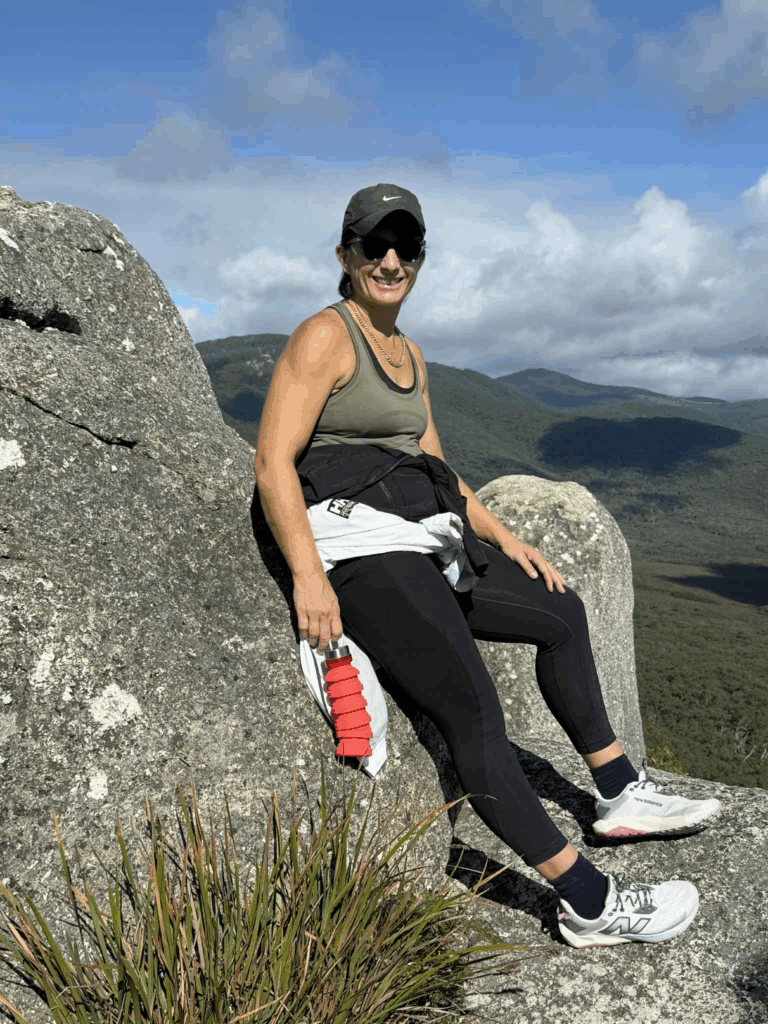
Sitting on top of a mountain – Wilson’s Promontory, Victoria, Aug 2025
And that’s where clarity arrived.
Not focusing on the problem created room for answers to reveal themselves. It was a bit like those puzzles where you’re told not to look at the image, but to look through it. And suddenly – there it was!
Solutions to complex deals. A “picture on a page” that would help explain something to an experienced CEO, CFO or board member (while preserving egos). A way to navigate a difficult staff situation. How to approach a challenging client conversation. How to support my daughters through whatever life was throwing at them. How to make the complex simple.
When the Eureka moment hit, my family learned the drill. I’d bolt into the house, grab post-it notes and a Sharpie, and shout: “Don’t talk to me – I need to write this down before I forget!”
My husband used to joke it looked a bit like a scene from A Beautiful Mind – a wall covered in post-it notes, which over time transformed from chaos into a simple, clear picture – a compelling and insightful story. (And yes – the colour of the post-it notes mattered 😊)

Who doesn’t love post-it notes???
It’s not just me – the research agrees
This isn’t just anecdotal. There’s a strong body of credible research showing that stepping away from a problem – through breaks, walking, mind-wandering or unrelated tasks – improves creativity, insight and problem solving.
In psychology and neuroscience, this is known as the incubation effect. Incubation refers to the unconscious processing of a problem when it’s set aside. When people return after a break, they often see solutions that didn’t appear through continuous effort.
So why does this matter?
∞ Better problem solving and creativity: Research shows that stepping away leads to higher solution rates than pushing through. One study found solution rates increased from 38% to 81% after an extended break. (Incubation and interactivity in insight problem solving. Henok, Vallée-Tourangeau & Vallée-Tourangeau, Psychological Research, 2020)
∞ Mind-wandering creates new connections: Light mental breaks (like walking or chores) allow the brain to form new associations unconsciously – leading to insight when you return. (Mind wandering during creative incubation predicts increases in creative performance in a writing task. McDaniel, Habibi & Kaplan, Scientific Reports, 2025)
∞ Improved wellbeing and performance: Even short micro-breaks (under 10 minutes) significantly improve wellbeing and help sustain performance by reducing cognitive fatigue. ((“Give me a break!” A systematic review and meta-analysis on the efficacy of micro-breaks for increasing well-being and performance. Albulescu et al., PLOS One, 2022)
∞ Restored focus and cognitive capacity: Attention Restoration Theory shows that stepping away from directed attention – especially in nature or low-demand activities – restores mental capacity and supports better focus and creativity afterward. (The experience of nature: A psychological perspective. Kaplan & Kaplan, 1989)
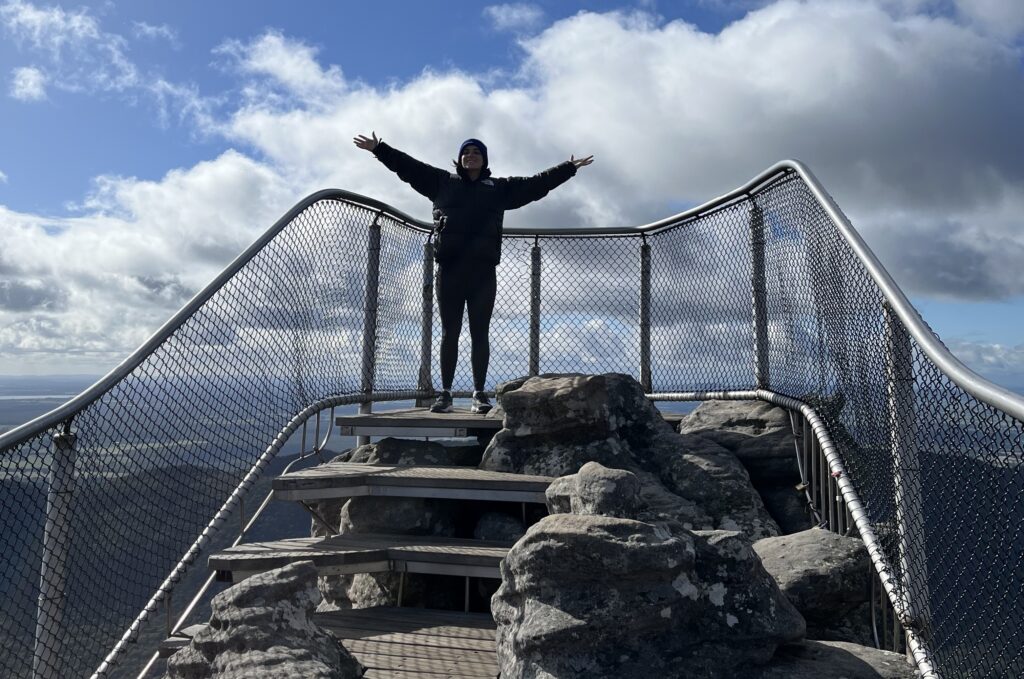
My youngest daughter Skyler, Pinnacle, Grampians National Park, Halls Gap
Closing thought
The next time you’re stuck, overwhelmed, or unable to “see the picture”, try stepping away. Do something different. Create space. Sometimes, having your head in the clouds (as my nana used to say) is exactly what’s needed – just remember to come back to earth eventually, because things still need to be done.
When you’re working through something tough, where do you find space? And what helps your best thinking emerge? (And be honest – do you love post-it notes as much as I do?)
About The Power of… newsletter series
These newsletters are a way for me to share practical reflections, tools and ideas on what really matters – the small shifts that make a big difference to career, life and legacy.