In a world that often rewards perfection, people pleasing, confidence and having all the answers, vulnerability can feel incredibly uncomfortable. But it is vulnerability, not certainty, that gives courage its meaning.
It is this discomfort that causes many of us, in our careers and in our lives, to become experts at building a shield, or as Brené Brown, author and one of the leading researchers into vulnerability calls it, wearing an armour.
∞ We work harder.
∞ We try to prove ourselves.
∞ We strive to be perfect.
∞ We tell everyone we’re “fine.”
∞ We avoid asking for help.
∞ We hide the parts of ourselves we worry others may judge.
All in the hope that if we look like we have everything under control, no one will see the uncertainty underneath, and they will think positively about us. The irony of this though is, it is often the uncertainty underneath that makes us most human. It allows us to be better leaders, colleagues, friends, children, wives, husbands, parents and so much more.
My motivation for my newsletters…
In my last The Power of… newsletter, I wrote about asking for help. The response was amazing. One story in particular has stayed with me. Someone who wasn’t even connected to me on LinkedIn read the newsletter. Afterwards, they reached out to one of my connections and simply said:
“You can blame Tracey Waring for this… but I need some help.”
My heart filled with pride when I heard this. Not because someone needed help, but because they had found the courage to admit it. It also made me consider that perhaps asking for help isn’t really about asking for help at all. Perhaps it’s really about vulnerability.
Why vulnerability feels so uncomfortable
Brené defines vulnerability as:
“The emotion we experience during times of uncertainty, risk and emotional exposure.”
Think about that for a moment. It’s not a weakness or a failure. It is simply uncertainty, risk and emotional exposure. Something that literally all of us have experienced in our careers and lives at some point, and for many, probably did so this week (or even today) …
∞ Starting your own business
∞ Giving difficult feedback
∞ Waiting for medical test results
∞ Apologising after getting something wrong
∞ Walking into your first day in a new role
∞ Watching your child leave home
∞ Having a conversation you’ve been avoiding
These are all acts of vulnerability.
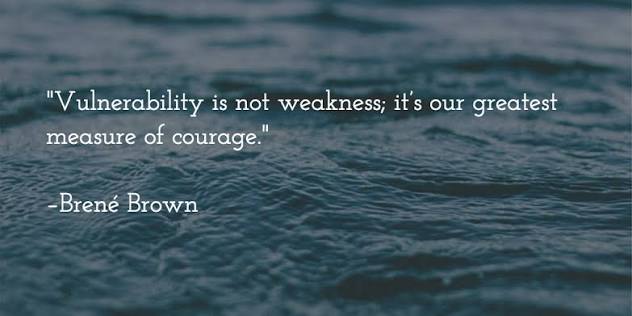
But many of us have been taught that courage means having confidence and being strong. Brené’s research suggests the opposite. There is no courage without vulnerability. This is because courage only exists when there is something meaningful at risk.
As she says:
My own lessons
Like I admitted in my previous newsletter, I wish I could tell you I have mastered vulnerability. I haven’t. Like asking for help, vulnerability is something I do, and have to, continue to practice.
Sometimes it has brought me closer to people, while other times… “TMI” (“too much information”) as my daughters and nieces would say!! Sometimes I’ve shared too much with someone who simply wasn’t ready to receive it. Or sometimes it’s “NEI” (“not enough information” – I think I just made that up!) I’ve kept far too much hidden because I worried what others might think.
Over time I’ve learnt that vulnerability isn’t about sharing everything with everyone. It’s about sharing the right things, with the right people, at the right time.
And I have no shortage of moments of vulnerability.
From a personal perspective, one of the hardest moments of my life was having to move my mum into an aged care facility. Her Parkinson’s disease and Parkinson’s induced dementia and the extreme toll it was taking on my dad made staying at home no longer viable. While we had exhausted every option and knew this was the only next step, every single time we walked out those doors, I questioned whether we had made the right decision.
There was no certainty. Only hope… that she would be OK, that we’d made the right decision. That she wouldn’t hate us forever.
Another was taking my daughters back to Timbertop, which is Geelong Grammar School’s famous Year 9 residential campus, located in the foothills of the Victorian Alps near Mansfield. It is a compulsory, full-year boarding program where students live in the bush for the full school year, disconnected from digital technology, learning to run in the hills, to build resilience, independence, and self-reliance. On many occasions, when returning them to the bus so they could head back after a mid or end of term break, they would desperately plead with me not to take them back.
Again… no guarantees. Just trusting that what felt difficult today would become one of the defining experiences of their lives. And fortunately, it did!
From a professional perspective, there were many examples I can reflect back on. Times when under pressure, I was cranky and a bit short and snappy with a team member, then having to go back the next day and apologise. Or the multiple times where I had to admit I didn’t know the answer to something, or that I’d come up with the wrong answer. Given a large percentage of my career was dealing in complex transaction and accounting structuring, there was no shortage of complex issues to navigate, with lots of grey zones we had to navigate through – and at times, I got things wrong and needed to revisit.
Looking back now, none of the situations called for strength alone. They called for vulnerability. The willingness to keep showing up when there were no guarantees. To admit I was wrong and that I wasn’t perfect.
The icebergs of our life… where is your waterline?
I’ve often thought about vulnerability a bit like an iceberg. Some parts of our lives sit above the waterline and that’s what everyone sees.
∞ Our career
∞ Our confidence
∞ Our achievements
∞ And at times, some not so positive responses and behaviours
But below the surface sits another story.
∞ The doubts
∞ The mistakes
∞ The losses
∞ The worries
∞ The moments when we don’t know what we’re doing
∞ The things we are navigating in our personal lives – family challenges, illness, financial stress and more
Many people tend to keep their waterline incredibly high because they fear judgement.
“If people knew what was really going on…”
“They’ll think I’m not capable.”
“They’ll think I don’t deserve to be here.”
“They’ll choose someone else.”
Or sometimes they feel like they are in a game of “whack a mole” – if you put your head up, and admit your doubts, uncertainties etc, you’ll put yourself in the line of fire – especially where restructures and cost cutting measures are occurring.
But there’s another extreme too. Some people’s waterlines are too low. Not everything belongs everywhere and should be shared with everyone.
“Bring your whole self to work” is a wonderful aspiration and it is usually well intended. However, not every part of our whole self belongs in every workplace or every conversation. I have been known to dance on a table or two and sing Karaoke – that may be ok for a bar, but not so much for the Board room.
Vulnerability isn’t oversharing. It requires wisdom, judgement and self-awareness.
And it is also where trust begins.
One of the key behaviours needed to create an environment to enable better connection, which I talk about as part of my Better Connected program is, “building trust”. While trust grows through empathy and active listening and develops over time, it also grows when people are prepared to let others see that they’re human. Admitting you don’t know, asking for help, acknowledging a mistake, sharing an appropriate challenge you’re navigating – these moments don’t weaken relationships – they strengthen them. They give others permission to lower their own waterline just enough to have a more honest conversation.
Of course, vulnerability isn’t an excuse for poor behaviour, nor does it mean sharing everything with everyone. But understanding a little more about another person’s iceberg often gives us something incredibly valuable: context. And where there is greater understanding, there is usually greater compassion – both for others and for ourselves
Why this matters for leaders and organisations
Over my 30+ years in professional services, I met countless technically brilliant leaders. However, the ones I and other people admired most weren’t the ones who appeared perfect, they were the ones prepared to admit they didn’t know. The ones who were willing to: apologise; ask questions; acknowledge mistakes; or to say, “I’m finding this difficult.” Or “I’m not sure.”
And the research supports this. In Brené’s work with leaders across organisations, she found that the ability to embrace vulnerability wasn’t simply another leadership quality – it was the foundation that enabled all the others.
Leaders who avoid uncertainty, risk and emotional exposure often avoid the very conversations that build trust, strengthen teams, encourage innovation and create accountability – the things that create the environment to enable better connection. In other words, if we aren’t prepared to be vulnerable, it becomes incredibly difficult to lead courageously and effectively.
And this is because perfect leaders aren’t relatable, human leaders are. The leaders we remember aren’t the ones who never fell. They’re the ones who were willing to show us that they fell and that they were still able to get back up.
Some reminders
You don’t learn and master vulnerability overnight. There are no 10 simple steps to follow. Brené coined the phrase “rumbling with vulnerability”, and she reminds us that:
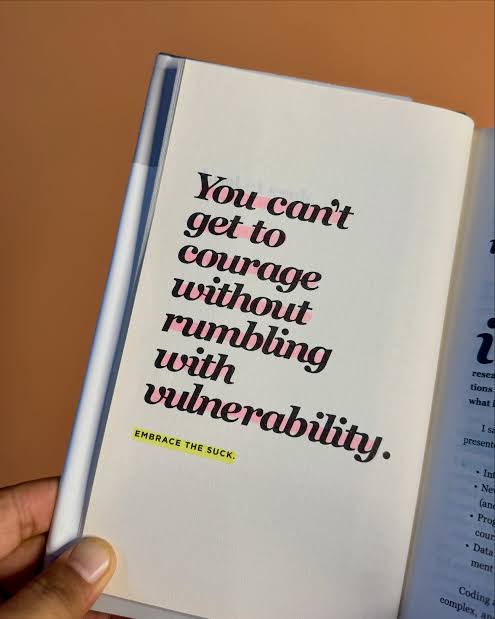
In this context, rumble is a way of saying “Let’s have a real conversation, even if it’s tough.” It’s a discussion, a conversation, or meeting defined by a commitment to lean into vulnerability, to stay curious and generous, to stick with the messy middle of problem identification and solving, to take a break and circle back when necessary, to be fearless in owning our parts and to listen with the same passion with which we want to be heard. (Source: “Dare to Lead” Brené Brown).
So as you start to rumble and embrace the suck, here are a few things worth remembering:
∞ Vulnerability is not weakness – it’s courage in action. Courage can only exist in the face of fear and only exists when something meaningful is at risk.
∞ Share with people who have earned the right to hear your story. Vulnerability isn’t for everyone every time. Trust matters.
∞ Perfection is not the goal. Growth almost always involves uncertainty, mistakes and learning.
∞ Your struggles don’t define you. They simply provide context to your story – and often create compassion and connection with others.
∞ The goal isn’t to remove discomfort. It’s to become more comfortable walking alongside it.
Closing thought
As I continue building my own practice, I still experience moments of vulnerability – almost every week.
Every:
∞ Meeting I have with a prospective client
∞ Proposal I send
∞ Keynote I deliver
∞ Time I write and press “publish” on one of these newsletters.
I never really know how it will be received.
The same goes in my personal life – raising my family, be a part of my marriage, continuing to care for my dad, being a sister and an aunty, and contributing to my community and society – many moments of uncertainty, risk and emotional exposure.
And maybe that’s exactly the point. Growth has never lived inside certainty; it has always lived just beyond it. After all, growth starts just outside our comfort zones. And maybe… that’s where courage has been waiting all along.
We can spend so much of our lives trying to protect ourselves from being ourselves, from being seen… when often it’s being ourselves and being seen that creates the most meaningful connection.
Connection with the people around us, with the people we lead, with the people we love. And perhaps most importantly… connection with ourselves.
Because the most important relationship we’ll ever build is the one we have with ourselves… and it starts with you.
I’m curious…
❓ Where in your life are you currently avoiding vulnerability because you’re trying to protect yourself?
❓ What conversation, decision or opportunity might require you to be just a little braver?
❓ And what could become possible if, instead of seeing vulnerability as weakness, you started seeing it as courage?
About “The Power of…” newsletter series
These newsletters are a way for me to share practical reflections, insights and tools on what really matters – the small shifts that can make a big difference to career, life and legacy.